
Cholesterol, ApoB and the lipoprotein profile
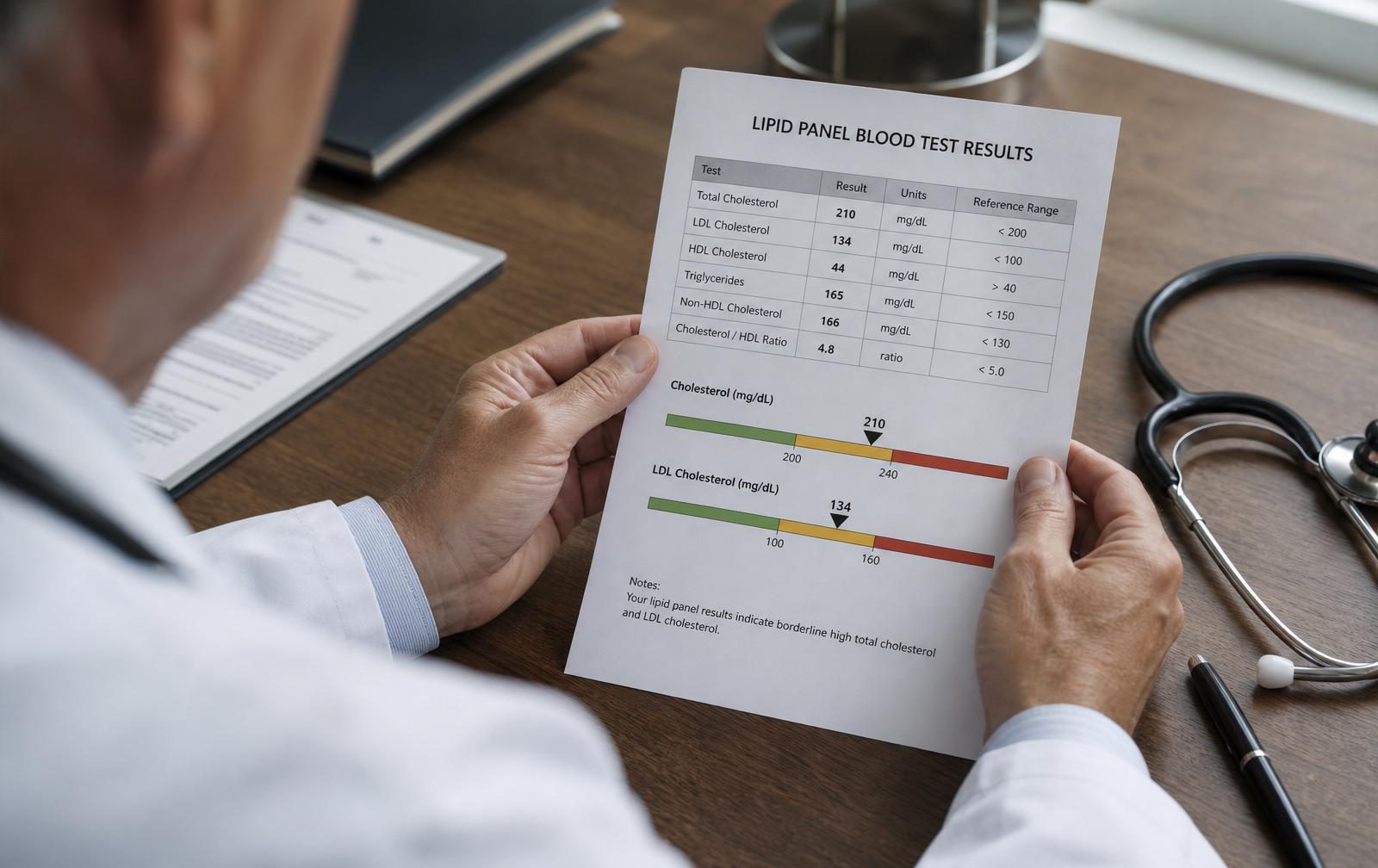
“High cholesterol” is one of the most misunderstood results in modern medicine. International guidelines (ESC/EAS) put LDL-C, non-HDL cholesterol and ApoB at the centre – these have the strongest causal evidence for atherosclerosis. Lp(a), hs-CRP, metabolic markers and body weight add context. Any single number only means something in context: age, sex, family history, blood pressure, smoking, insulin sensitivity and existing conditions.
- LDL-C, non-HDL and ApoB are the guideline-level target markers
- ApoB refines risk especially with high triglycerides or a “normal” LDL
- Lp(a) and hs-CRP refine risk; homocysteine and fibrinogen are selective add-ons
What cholesterol is – and why the standard test misses half the picture
Cholesterol is not a “bad substance.” It’s the raw material for every cell membrane, for hormones like testosterone, estrogen, and cortisol, and for vitamin D. Your liver makes about 80% of the cholesterol in your blood; only about 20% comes from food.
Cholesterol doesn’t dissolve in water, so it travels through the blood inside carrier particles called lipoproteins – LDL, VLDL, IDL, HDL, and Lp(a). Every one of these particles carries a protein called apolipoprotein B (ApoB) on its surface, except HDL, which carries ApoA instead. Measuring ApoB tells you exactly how many artery-clogging particles you have – something the standard “LDL cholesterol” number (measured in weight) cannot show.
Two people can have the same LDL-C (say 3.5 mmol/L) but very different risk. One may have large, fluffy LDL particles in small numbers (phenotype A – lower risk). The other may have many small, dense LDL particles (phenotype B – higher risk). Same amount of cholesterol, very different risk.
Warning signs and a higher-risk profile
- Trig/HDL ratio above 1.5 – an indirect sign of phenotype B (small, dense LDL) and insulin resistance
- Family history of an early heart attack (before 55 in men, before 65 in women)
- Diagnosed familial hypercholesterolemia (FH – an inherited condition that causes very high cholesterol)
- Xanthelasma (yellow patches on the eyelids) or a gray ring around the cornea before age 50
- Thickening of the arteries seen on a carotid or abdominal ultrasound
- Metabolic syndrome: extra belly fat, high blood pressure, and insulin resistance together
- An ongoing inflammatory condition (autoimmune disease, gum disease, inflammatory bowel disease)
- Smoking and chronic stress – both speed up atherosclerosis (plaque buildup) even with “normal” LDL
Read the full article
Enter your email and the full text opens right here on this page.
Go deeper: lipidology and cardiovascular webinars
Recorded webinars on ApoB, lipoproteins and cardiovascular risk assessment – with Dr Saadi.
Lipiidiprofiili sihttasemed
Sihtväärtused sõltuvad kardiovaskulaarsest riskist (ESC 2019, EAS 2022)
| Marker | Madal risk | Mõõdukas / kõrge risk | Väga kõrge risk |
|---|---|---|---|
| LDL-kolesterool | < 3,0 mmol/l | < 2,6 mmol/l | < 1,4 mmol/l |
| ApoB | < 100 mg/dl | < 80 mg/dl | < 65 mg/dl |
| Triglütseriidid | < 1,7 mmol/l | < 1,5 mmol/l | < 1,5 mmol/l |
| HDL-kolesterool (M / N) | > 1,0 / > 1,2 mmol/l | sama | sama |
| Lp(a) | < 30 mg/dl (< 75 nmol/l) | sama | sama |
| Non-HDL kolesterool | < 3,8 mmol/l | < 3,4 mmol/l | < 2,2 mmol/l |
| Homotsüsteiin (valikuline lisanäitaja) | labori referentsvahemik | sama | sama |
LDL-kolesterool
- Madal risk
- < 3,0 mmol/l
- Mõõdukas / kõrge risk
- < 2,6 mmol/l
- Väga kõrge risk
- < 1,4 mmol/l
ApoB
- Madal risk
- < 100 mg/dl
- Mõõdukas / kõrge risk
- < 80 mg/dl
- Väga kõrge risk
- < 65 mg/dl
Triglütseriidid
- Madal risk
- < 1,7 mmol/l
- Mõõdukas / kõrge risk
- < 1,5 mmol/l
- Väga kõrge risk
- < 1,5 mmol/l
HDL-kolesterool (M / N)
- Madal risk
- > 1,0 / > 1,2 mmol/l
- Mõõdukas / kõrge risk
- sama
- Väga kõrge risk
- sama
Lp(a)
- Madal risk
- < 30 mg/dl (< 75 nmol/l)
- Mõõdukas / kõrge risk
- sama
- Väga kõrge risk
- sama
Non-HDL kolesterool
- Madal risk
- < 3,8 mmol/l
- Mõõdukas / kõrge risk
- < 3,4 mmol/l
- Väga kõrge risk
- < 2,2 mmol/l
Homotsüsteiin (valikuline lisanäitaja)
- Madal risk
- labori referentsvahemik
- Mõõdukas / kõrge risk
- sama
- Väga kõrge risk
- sama
Väga kõrge risk = varasem infarkt/insult, diabeet koos elundikahjustusega, krooniline neeruhaigus, familiaalne hüperkolesteroleemia. Sihtväärtused on juhendite üldised orientiirid ja neid kohandatakse alati individuaalselt. LDL, non-HDL ja ApoB on peamised sihtnäitajad; homotsüsteiin on valikuline lisanäitaja ilma üldise ravieesmärgita.
Frequently asked questions
Go deeper: related materials
Related topics
Metabolic health is interconnected – explore the other deep-dives:
Insulin resistance
The root of metabolic disease – 5–10 years before diabetes appears.
ReadOverweight
Why calorie counting fails – hormones, insulin, leptin and adipose tissue.
ReadVagus nerve
The rest-and-repair system – digestion, heart, inflammation, stress.
ReadSleep
The foundation of metabolic health – hormones, cortisol, insulin, brain recovery.
ReadChronic inflammation
The ‘silent fire’ behind cardiovascular disease, diabetes and autoimmunity.
ReadLow-carb and keto
Carbohydrate restriction – IR, T2D, fatty liver, metabolic syndrome.
ReadAgeing
Glycation, insulin, inflammation and muscle – what you can influence yourself.
ReadTeaduslikud allikad
- Mach F et al. 2019 ESC/EAS Guidelines for the management of dyslipidaemias. European Heart Journal, 2020. doi.org/10.1093/eurheartj/ehz455
- Sniderman AD et al. Apolipoprotein B Particles and Cardiovascular Disease: A Narrative Review. JAMA Cardiology, 2019. doi.org/10.1001/jamacardio.2019.3780
- Kronenberg F et al. Lipoprotein(a) in atherosclerotic cardiovascular disease and aortic stenosis (EAS Consensus Statement). European Heart Journal, 2022. doi.org/10.1093/eurheartj/ehac361
- Bhatt DL et al. Cardiovascular Risk Reduction with Icosapent Ethyl for Hypertriglyceridemia (REDUCE-IT). NEJM, 2019. doi.org/10.1056/NEJMoa1812792
- Jenkins DJA et al. Effects of a Dietary Portfolio of Cholesterol-Lowering Foods vs. Statin. JAMA, 2003. doi.org/10.1001/jama.290.4.502
- Ference BA et al. Low-density lipoproteins cause atherosclerotic cardiovascular disease. 1. Evidence from genetic, epidemiologic, and clinical studies (EAS Consensus). European Heart Journal, 2017. doi.org/10.1093/eurheartj/ehx144
- Sacks FM et al. Dietary Fats and Cardiovascular Disease (AHA Presidential Advisory). Circulation, 2017. doi.org/10.1161/CIR.0000000000000510
- Cannon CP et al. Ezetimibe added to Statin Therapy after Acute Coronary Syndromes (IMPROVE-IT). NEJM, 2015. doi.org/10.1056/NEJMoa1410489
Dr Sergey Saadi – expert in advanced lipidology and metabolic health
Dr Sergey Saadi is a physician with over 15 years of clinical practice.
- Clinical approach: guideline core markers (LDL, non-HDL, ApoB) together with the full risk profile and metabolic context
- Regular speaker in media and in clinician training
- Author of “Dangerous secrets of blood sugar” (Varrak)
This page is educational and general. It is not personal medical advice, a diagnosis or a treatment plan. Discuss changes with your doctor.